Visual noise
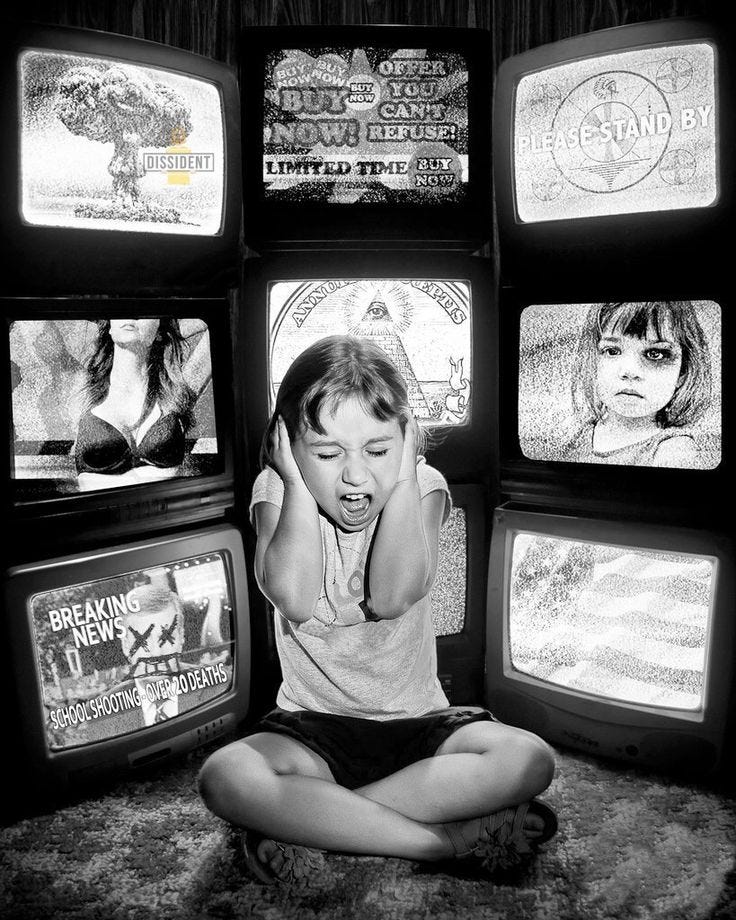
Ads, popups, notifications and multiple tabs fight for your attention, breaking your focus every few seconds.
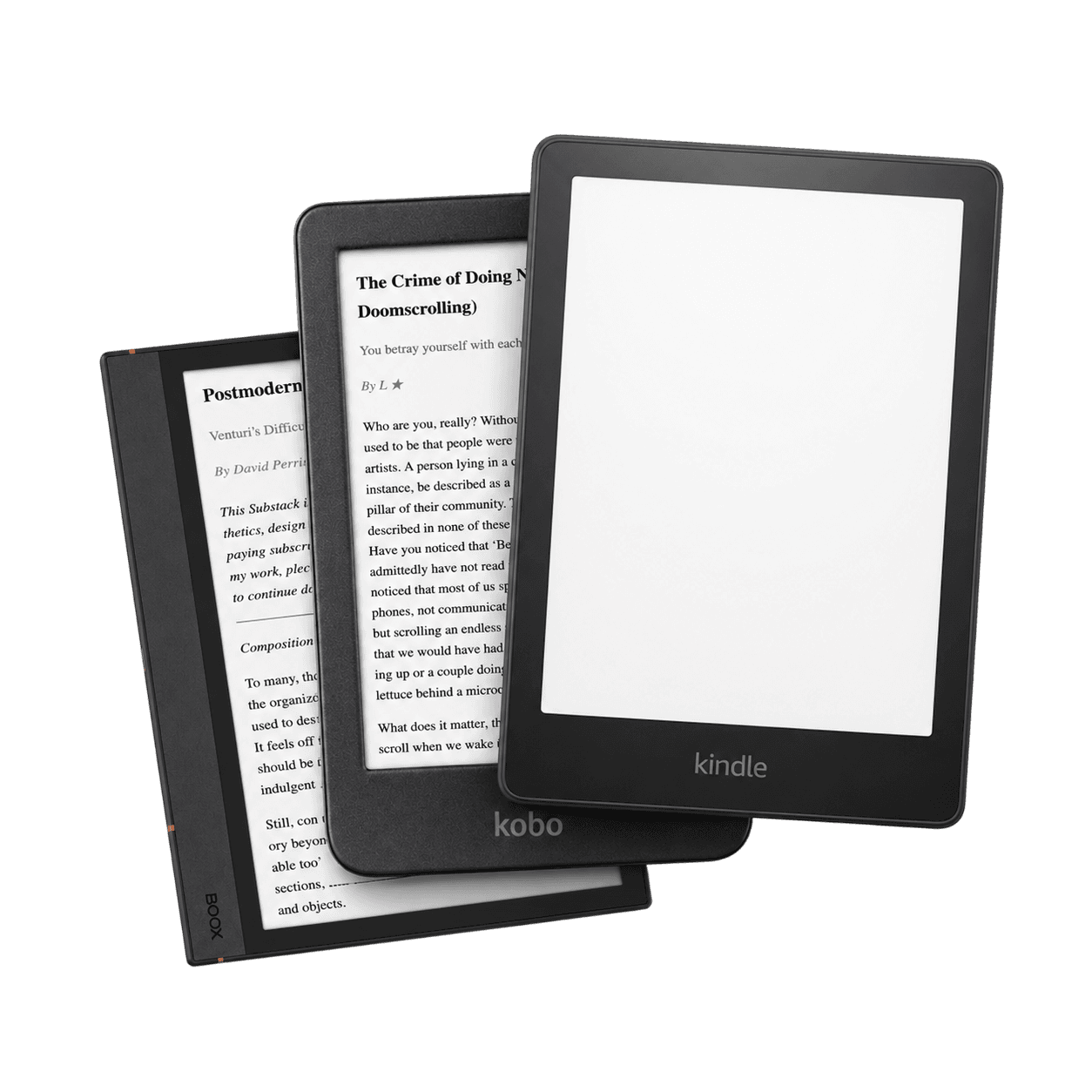
Turn web articles and newsletters into books for your e-reader, so you can read more while reducing your screentime.
Substack
You betray yourself with each Instagram reel
By L ★
Who are you, really? Without the things you like, who are you? It used to be that people were philosophers, or readers, or athletes, or artists. A person lying in a coffin at their own funeral might, for instance, be described as a great thinker, an excellent speaker, or a pillar of their community. Most of you, and most of us all, will be described in none of these ways, because we don’t do anything at all. Have you noticed that ‘BookTok’ is littered with people who self-admittedly have not read 80% of the books they buy? Have you noticed that most of us spend upwards of 8 hours a day on our phones, not communicating (the supposed function of the telephone) but scrolling an endless reel of nothing; consuming video after video that we would have had no interest in searching for of someone dressing up or a couple doing something or somebody’s guinea pig eating lettuce behind a microphone.
What does it matter, though, that we do nothing all day? That we scroll when we wake up, and before we go to sleep, and under our desks at work, and while we sit on the bus or in traffic. What does it matter that not a single hour of any of our days goes into action—actually doing something?
It matters because you are no one. What do you like to do, outside of school or work? Maybe it is photography, or gardening, or basketball. Now what do you actually do, outside of school or work? The discrepancy is the issue—the tragedy of consumption that once cursed every person under twenty years old in the age of YouTube, but which now curses even your mother and some of your grandmothers. Liking something is not doing it, and even Aristotle knew that character is not built of preferences alone, but out of action. Owning books is not reading, watching fitness content is not exercising, saving recipes is not cooking. For many, identity by association has replaced identity by practice. How do you expect to ever be good at anything without putting your time into it, rather than into YouTube shorts and Twitch streams?
I have written and will write endlessly of the ways that our capitalist societies drive us to this tragedy; how meaningless grating 8 hour shifts spent staring at spreadsheets or explaining the concept of coupon expiration dates to angry customers leaves us exhausted and not at all inspired, and how our time spent consuming or doing nothing feels like a break from capitalism while acting as one of its most powerful tools. Alienated labor drains vitality and estranges us all from our human capacities, and we have all therefore become wage-slaving robots without thoughts or opinions or hobbies of our own, and none of us seem to be doing anything at all. Does the death of your personhood not plague your mind? Does the tragedy of the depersonalization of an entire society not worry anyone? We know that convenience technologies have become extraction tools, but we seem to fail to meaningfully realize that their extraction of our attention, which becomes the extraction of time, has extracted from us the latter part of ‘human being.’ Now we are just human, and soon we might not even be that.
The latter half of the 20th century was rife with massive efforts towards the individuation of society—and back then people still had hobbies. Today, the products of those alternative movements are uniquely fetishized—that is, removed from their conditions and contextual conceptions. Millions will watch videos titled “Goth girls date 10 nice guys” that masquerade as brainless dating content but are actually and more insidiously advertisements for more short-form content on OnlyFans, littered with buzzwords and phrases like “fuck the system” spouted five seconds before a woman spits into a man’s mouth. Yet, even more millions will consume this content only partially through trending TikToks and Instagram reels, and these same millions of people will consume 30 seconds of 500 more videos or movies or TV shows that they previously had no intention of searching for and futurely have no intention of actually watching. Let us rather consume everything, even the least thought-provoking brainless 'entertainment,' as a 15-second dopamine hit, and let those videos that are supposed to serve as entertainment actually function as advertisements for short-form pornography. Of course entertainment is not itself a vice, but the optimization of every piece of media for immediate stimulus inevitably weakens our capacity for sustained engagement with it, which is really entertainment’s only absolute virtue.
There is so much spiritual and intellectual death in the short-form-ification of every piece of media. On top of this, we betray ourselves personally by relegating every minute of every hour of our free time to not only thoughtlessness but actual nothingness. In my estimation this is inextricably linked to the rising normalization of procrastination. Every small act that once made up a human being’s day is now put off in favor of the consumption of bite-sized snippets of brainless content that is actually advertising you to masturbate to barely legal and genitally bald women pitching up their voices for the satisfaction of men and women everywhere indoctrinated with the sexual fetishes of the Epstein class. I feel compelled to reiterate that consumption is not the issue at all; where there is creation, there must be consumption. The issue, and the tragedy, is that mindless compulsive consumption we have all surrendered the days of our lives to.
Beyond this there is something even darker than distraction itself: the normalization of self-betrayal. While we fail to become ourselves—to do anything enough to entrench it into our being—we narrate that failure as harmless, funny, inevitable, relatable. We take to the same platforms that destroy our personhood to collectively laugh about never starting anything, about rotting in bed, and we make more thoughtless short-form content about this impotence. Thus, while we collectively waste our lives, we normalize it such that we come full circle—cycling precisely back into the same loop that steals the minutes of our lives in the first place.
Further than this, a civilization reveals itself by what it makes ordinary. Ours has made chronic distraction ordinary. It has made fractured attention ordinary. It has made the inability to sit still ordinary, the inability to read a page without checking a screen ordinary, the inability to endure silence ordinary. Most chillingly, it has made the surrender of one’s will feel natural. If a person in another age confessed that they spent six hours daily staring at rapidly changing images they did not choose while neglecting their personal aspirations, it would sound like captivity. Today, it is Tuesday.
The human being was not built for this degree of passivity. We are creatures designed for effort, orientation, devotion, memory, craft. There is a dignity in applying oneself to something resistant: wood that must be carved, soil that must be turned, language that must be mastered, muscles that must be trained, a community that must be served. Friction creates character, but the digital marketplace has removed all friction except the friction of stopping; everything is effortless except escape. And because effort is increasingly absent, so too is pride. Not vanity—we see much of that—but pride in the traditional sense: the quiet satisfaction of having done something difficult and real. To finish a book, to repair a sink, to cook for friends, to learn a sonata, to keep a garden alive through summer, to become dependable—these things generate a self that no post or aesthetic curation or branding exercise can imitate. Compare that feeling with the emptiness after three hours of scrolling. One enlarges you; the other leaves no trace at all. None of this means one must become austere or reject pleasure. Leisure is not the enemy. Entertainment is not the enemy. Even idleness has its place. The enemy is the colonization of all unstructured time by systems designed to prevent reflection and, in doing so, unendingly delay action. The enemy is forgetting that free time was once the space in which a person became someone.
So please, for the sake of the very salvation of humanity itself, get up, get off your phone, and do something.
We help readers get their content offline easily, to read more, reduce screentime and feel better.
The problem isn't your attention span, it's the devices you read on.
Ads, popups, notifications and multiple tabs fight for your attention, breaking your focus every few seconds.
Reading online feels slower and more draining than reading on paper. Research shows screen reading often leads to lower comprehension and faster burnout.
Hours on backlit screens dry out your eyes, blur your vision, and make long reading sessions uncomfortable.
Send your articles and newsletters to your reading device in one click

Step 01
Create your account and connect your e-reader in two minutes.

Step 02
Send any article to your device in one click with the browser extension or the web app, or download a well-formatted PDF to print your articles.

Step 03
Articles arrive on your device right away. Read it offline, with no distractions and less eye strain.













...and much more
Choose the article you want to read, and send it to your device in seconds.
Slow Boring
A banal take with serious consequences
By Matthew Yglesias
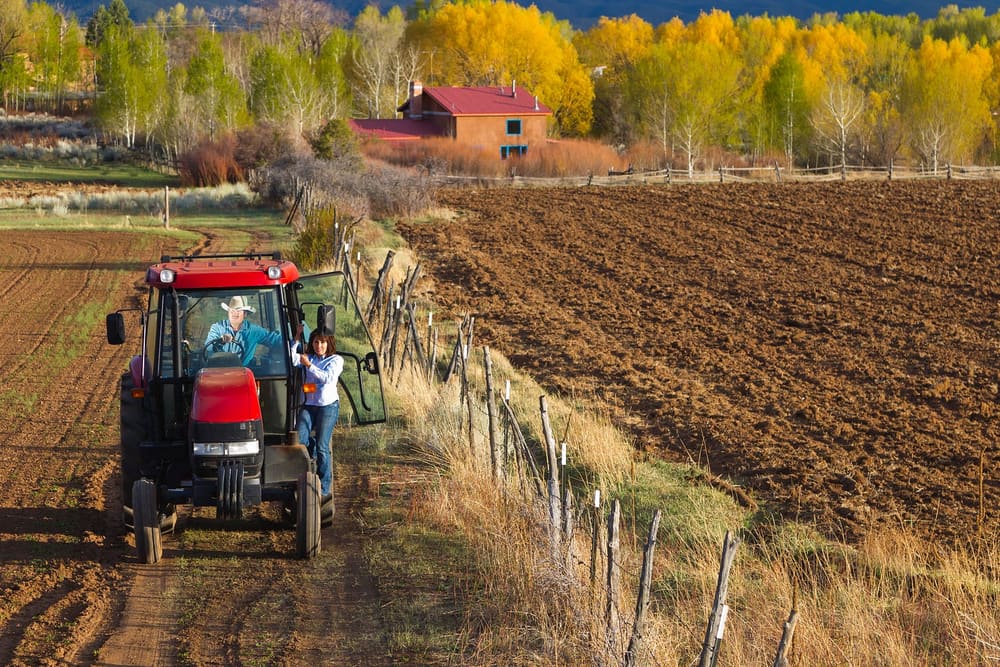
Along with my controversial view that dogs aren’t people, a subtly significant claim I believe to be accurate and consequential is that farms aren’t nature.
I think the vast majority of people, including people with a healthy appreciation for the value of economic growth, think there’s an important role for public policy in preserving nature. The exact nature of that role is, of course, controversial. You don’t see Donald Trump pushing to sell the Grand Canyon to build a golf course or California YIMBYs calling for midrise apartments in Yosemite. But outside of the most obvious examples, people have somewhat different intuitions as to what nature even is.
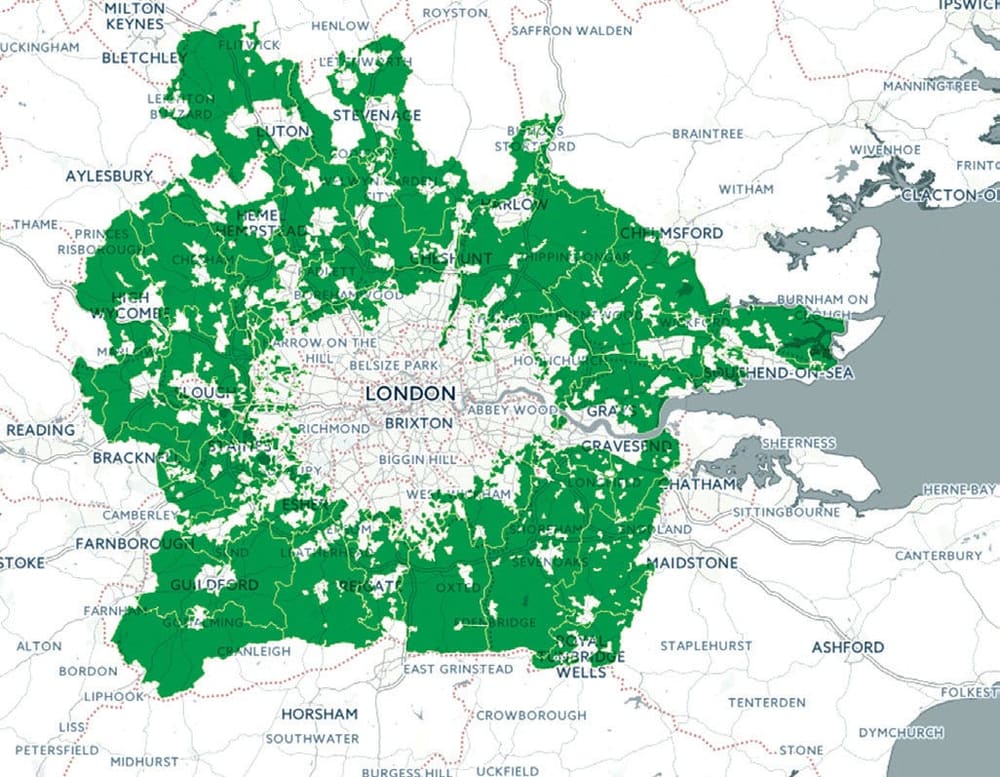
For example, London (like other British cities) is surrounded by an extensive green belt in which housing development is heavily restricted. This is obviously a costly economic policy given the country’s acute housing shortage. What I think is not clear from the map is that the “green” in the green belt is not parks or woodland but mostly farms with a smattering of golf courses and other sports facilities.
In the United States, we don’t typically have policies like that. One exception, though, is that Montgomery County in the D.C. suburbs has an extensive Agricultural Reserve where, similarly, suburban sprawl is banned.
But what you get in exchange for the development ban is not parkland or nature preserves but (mostly) small farms that absent regulation would not be an economical use of the land. Many of these appear to be hobby farms or derive the majority of their revenue from use as wedding venues or the like. Regardless, the Agricultural Reserve is, in effect, a kind of super-duper large-lot zoning, not a “conservation” policy as I would understand it.
Freddie deBoer called me out the other day for some intemperate remarks on British cultural and political attitudes toward housing, and I think he had a basically fair point. I try to advocate for pragmatic, non-expressive politics, and when it comes to the United States of America I think I do a pretty good job of it. Since I don’t actually live in Britain or cover British politics professionally, it can be fun to mouth off. But it’s bad practice. So I’ll say that I do not really understand the culture, legacy, or history of these British green belts. I will simply observe that in the United States of America, we do not normally understand farms to be part of the category of “nature” that we are trying to protect with environmental law, and this is a strength of American society. But we do have exceptions, and I’m a bit concerned that these exceptions are growing.
I’m writing from Maine, a state renowned for its natural beauty.
It’s also a state that after decades of population decline has seen rapid population growth since Covid, which is creating a lot of pressure on housing prices. That’s especially true because the places where remote workers want to live — and therefore where people who want jobs doing locally facing services for remote workers want to live — are not necessarily the mill towns that lost population during the decline years. The state has passed some major YIMBY laws to address the housing crisis, but I think common sense says that the state will also want to take measures to ensure the preservation of the aforementioned natural beauty.
One way this happens in Maine is through conservation easements.
In a conservation easement, a landowner stipulates that future development will be restricted on all or part of a property. Enforcement of the conservation easement falls to one of the various land trusts that exist around the state. The restriction reduces the fair market value of the property, which generates an income tax deduction (and, if applicable, estate tax savings) while also lowering the landowner’s property-tax liability. In exchange, the status quo is preserved.
This broadly makes sense to me. The former owner of a property I can see across the water from my house placed it under a conservation easement in partnership with the Maine Coast Heritage Trust. It is nice to look at from afar and makes for a fun, easy hike to take visitors on.
But there’s no legal requirement that a conservation easement involve opening the land to the public like this. What’s more, there’s not even a legal requirement that it be a nature preserve! From a tax standpoint, what’s going on is that by forswearing development rights, you are reducing the value of the land.
Nearby, the Blue Hill Heritage Trust has a Farmland Forever program that encourages people to create conservation easements that stipulate that land cannot be used for future housing development because it’s going to be a farm.
It’s of course true that if you take a parcel of land that could potentially be valuable if subdivided into housing and say “nope, this is going to be a farm forever,” this reduces the economic value of the land. But is giving a person a tax break for doing something economically perverse with a parcel of land really a good idea? What if a plumber had agreed in 2002 to stipulate that his plumbing business would never use cell phones or email or launch a website? That would reduce the value of the business. But you wouldn’t want the tax code to encourage people to run their businesses in a dumb way.
You can even go to fundraising dinners at the local country club where upscale residents will, I guess, donate money to the cause of encouraging people to get tax breaks for restricting housing development on their land.
It seems like it’s basically just NIMBYism with a vague high-minded gloss.
Blue Hill Heritage Trust grimly warns that “as land values rise and properties are subdivided, agricultural land can quickly be converted to housing and other uses. Once these productive soils are developed, they are effectively removed from agricultural use forever.” That may or may not be true, but it’s absolutely true that once land is placed under a perpetual conservation easement barring residential development, it is (by definition) removed from residential use forever. And for what? Small-scale New England farms haven’t been a major part of the American economy since railroads were built in the late 19th century.
Which, of course, is not to say that people shouldn’t be allowed to operate farms in Maine or wherever else they want to. I like farmers’ markets and paying a premium for fresh local produce as much as the next upscale liberal.
But I also want people to have places to live and reasonable commutes. I want builders and the people who manufacture the stuff that goes into homes to have jobs. I want towns to have tax revenue so they can support schools and roads. Bearing an economic cost to preserve nature seems reasonable to me. But part of how you get there is you allow more development so your town has a larger revenue base. That lets your town acquire more choice parcels for parkland rather than just freezing random small-scale developments in amber.
Cutesy farms in cutesy coastal towns are a kind of funny edge case for both nature conservation and agriculture.
What I think is underappreciated, though, is the tradeoff around the large commercially viable farming operations that genuinely underpin the American agricultural sector and, to some extent, the entire global food system.
These farms are mostly not cutesy, and people express relatively little desire to preserve them. Indeed, they often express the desire to have less nasty “agribusiness” and more cutesy farms.
The problem with this is that, as Michael Grunwald’s great book on agriculture from last year points out, the big nasty commercially viable farms are the way they are because they are dramatically more efficient. A single cutesy farm in a cutesy town looks nice, but it’s not producing enough food to feed the town. Agriculture that is less intensive, less efficient, and more localized would require widespread deforestation. And yet even with relatively intensive modern methods, the national footprint of agriculture is much larger than all the cities and suburban subdivisions and strip malls combined. Over a third of federally owned land is used for grazing.
I’m not going to say that this is bad; obviously, it’s good to have food.
But it does underscore that biofuels subsidies are a crazy agricultural policy. Shrinking the footprint of nature in order to grow more corn in order to turn corn into a gasoline additive is ridiculous — especially if you keep in mind that farms aren’t nature.
I heard Bill McKibben tell Ezra Klein recently that America doesn’t need more energy because “we already use huge quantities of it, and we use it strangely.” This is wrong, though. If we had much more abundant energy, then vertical farming would be economically viable for at least some crops and we could get by with much less farmland — and much less pesticide — and have more room for homes and for nature.
…select to see the converted articles
Offline reading on e-ink is easier on your eyes, your attention, and your comprehension.

PLOS ONE
2013
E-Ink can feel closer to paper.
PLOS ONE
2013
Less screen fatigue. More reading.

Acta Psychologica
2023
The web is built for clicking. Reading is built for focus.
International Journal of Industrial Ergonomics
2021
Made for pages, not endless scrolling.

Frontiers in Psychology
2025
Fewer distractions. Deeper reading.




..and any device with cloud sync or kindle app
Paste any Substack or Medium article link and send a clean EPUB straight to your device in seconds. No account required.
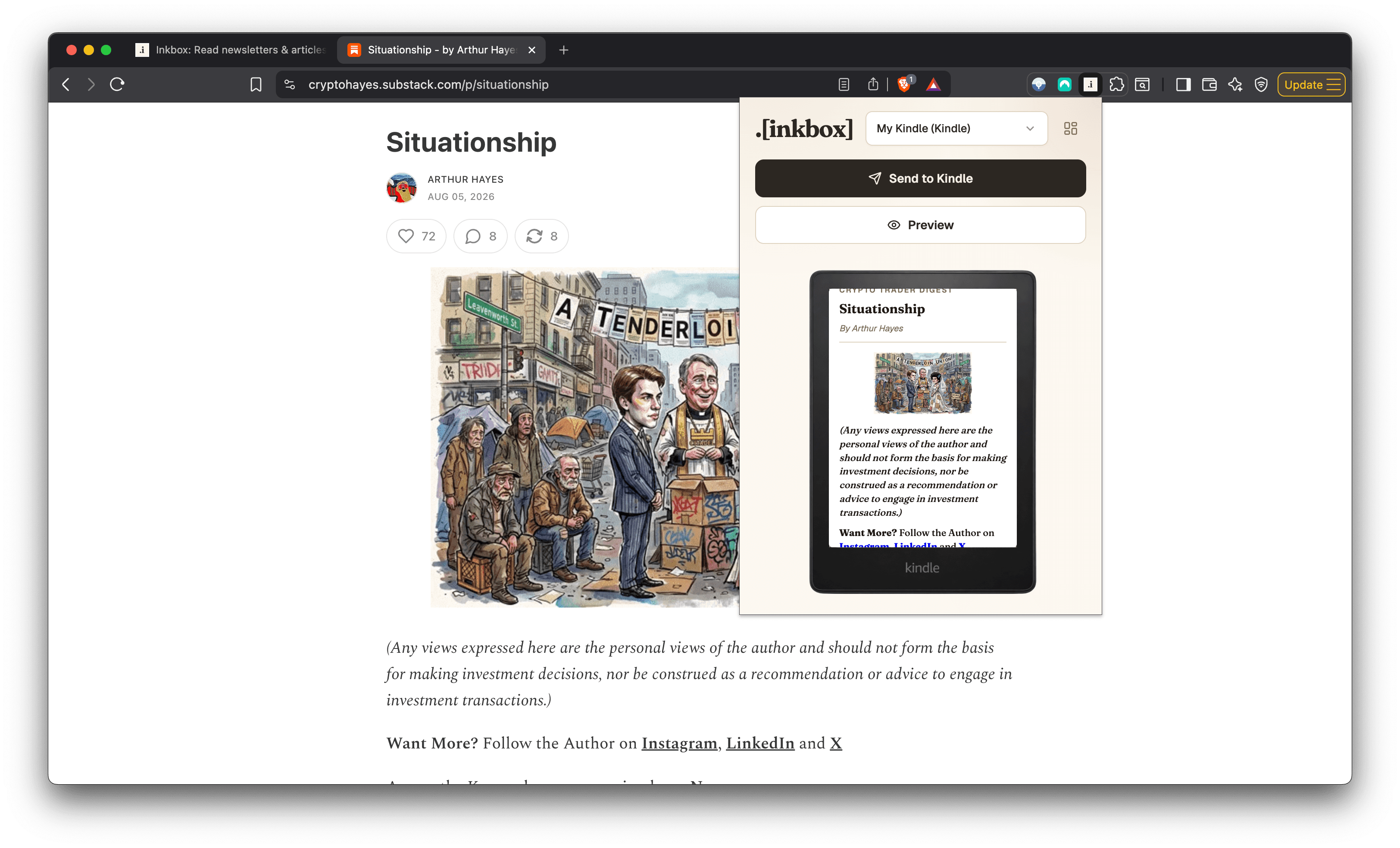
Keep browsing as usual. When you find an article worth reading, open Inkbox browser extension and send it to your device without copying links or switching tabs.
Bundle the articles and newsletters you care about into personal issues that arrive on your e-reader when you want them.
Free tools
Inkbox turns the web's best writing into clean files for your e-reader. No account required.

Read offline, feel better
 Add to Chrome
 Add to Firefox